
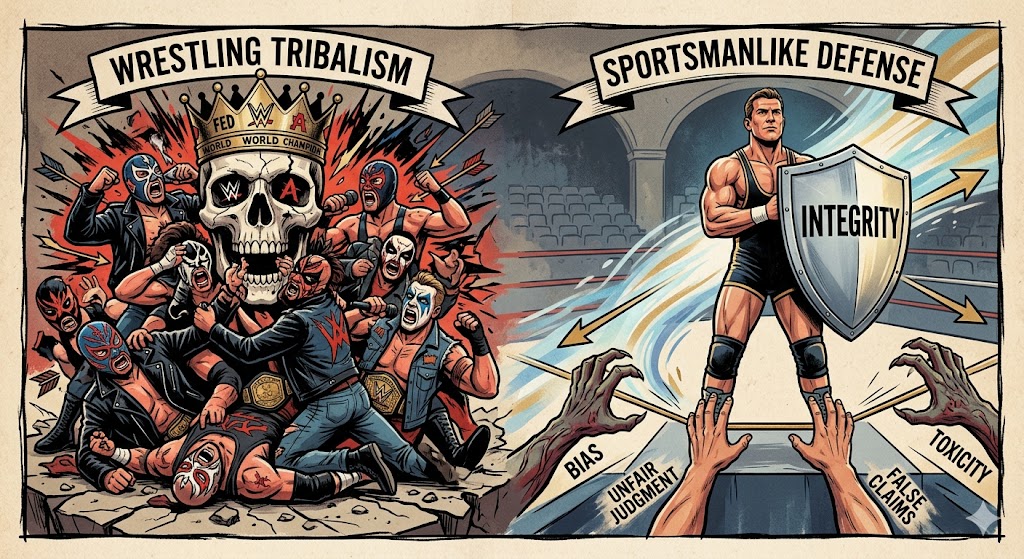
To the men and women in the ring: we see you. We see the grueling schedules, the physical toll, and the genuine bonds you form across company lines. We understand that in an industry this small, your coworkers are your family, and your "competitors" are often your best friends. We know you want to support each other, and we know you're tired of the "tribalism" that defines modern wrestling discourse.
But there is something the locker room needs to understand: the fans didn't choose this war. We didn't invent "counter-programming" or "counter-marketing." We didn't create an environment where exclusivity and collusion are the default settings. Tribalism isn't a grassroots movement; it's a top-down strategy that has filtered through generations of the business, designed to stifle collaboration and maintain a monopoly on the culture.
The Myth of the "First Stone"
While the internet loves to debate who "cast the first stone," those of us paying attention to history don't have to guess. When you look at the track record of certain entities—the history of disrupting contract negotiations, the calculated efforts to squeeze out smaller promotions, and the aggressive posturing to prevent talent from working where they choose—the pattern of collusion is clear.
True "collaboration" is not just a buzzword; it’s a healthy ecosystem where the industry thrives together. For some, however, success is only measured by the failure of others.
Why We Are Walking Away
This isn't about "brand loyalty" or being a "fanboy." It’s about a moral threshold. To the wrestlers: we know you support your friends, but we can no longer participate in supporting the structures that house them.
When a company's history is marred not just by bad creative, but by heinous acts—lawsuits involving sex trafficking, drug usage, and systematic abuse—it ceases to be a matter of "which show is better." The ongoing litigation surrounding figures like Janel Grant isn't a "shitty take"; it’s a documented reality of institutional rot.
We are not being "tribal" when we choose to ignore a company's existence. We are being consistent. We are choosing to put our energy into the places that, while not spotless, have shown a significantly higher regard for human dignity and collaborative growth.
To the Workers: We Wish You Well
Choosing to ignore a company does not mean wishing failure upon the individuals inside it. We want you to be paid, we want you to be safe, and we want you to excel. But we refuse to be "neutral" in the face of history that includes the exploitation of the vulnerable.
Most people you view as "tribalistic" are actually just trying to defend the version of wrestling they believe in—one that doesn't require us to look the other way for the sake of entertainment. We will defend any wrestler, in any company, when the time comes and it's necessary. But until the culture of collusion and the legacy of horrific acts are fully dismantled, some of us are choosing to stay home.
We aren't attacking you. We’re holding the line for the industry you deserve.
← Return to Feed