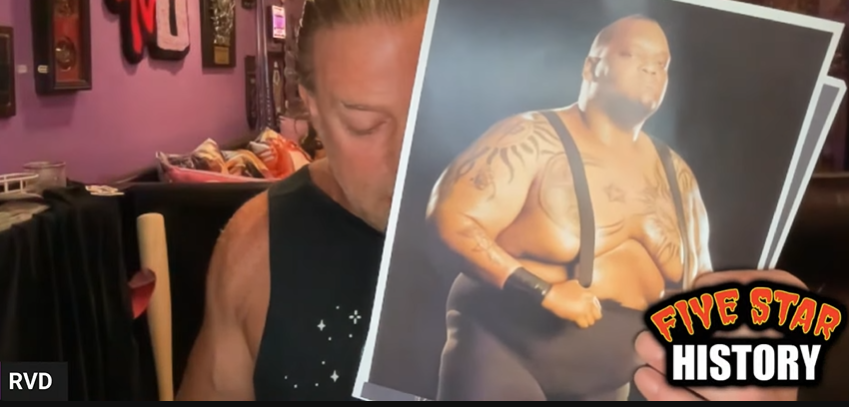
There are wrestling conversations that are about wrestling, and then there are conversations that start with wrestling and somehow end up somewhere much deeper. That was the feeling watching Rob Van Dam and Dominic DeAngelo talk about the loss of Nelson Frazier, better known to wrestling fans as Viscera, Mabel and Big Daddy V. What began as a recollection of Frazier became a much larger conversation about death, guilt, friendship, coworkers and the families that exist beyond the wrestling business. RVD explained that Frazier’s wife sent him a note and photographs following his passing. Although the two were not necessarily best friends, receiving that gesture affected him. Reading the note left RVD with a sense of guilt—a feeling that can be difficult to explain unless you have experienced the strange aftermath of losing someone you knew, even if you were never especially close.
That discussion opened the door to something wrestling fans do not always consider when another name disappears from the business: the people left behind. RVD and DeAngelo talked about wrestlers who died young, including Bobby Duncum Jr., and about the peculiar experience of attending funerals for people you knew primarily through work. Wrestling is an unusual profession in that regard. You can spend years traveling with somebody, sharing locker rooms, working shows and knowing their professional life while knowing almost nothing about the people waiting for them at home. Then you arrive at a funeral and suddenly meet the wife, husband, children, parents and friends who knew an entirely different version of that person. The wrestler you knew is suddenly somebody’s son, somebody’s daughter, somebody’s spouse or somebody’s parent. It can be a brutal reminder that the character, performer or coworker you thought you knew was only one small part of an entire human life.
The conversation eventually touched on Eddie and Vickie Guerrero and the way wrestling families can become visible to coworkers and fans under the worst possible circumstances. It is something the business has demonstrated repeatedly. Fans become familiar with the entrance, the music, the championships, the rivalries and the personality presented on television. The families often remain somewhere outside the frame. Sometimes, the first time a wrestler’s colleagues encounter those family members is at a funeral. That reality makes grief in professional wrestling particularly complicated. There is the loss of the person you knew, but there is also the sudden realization of the enormous network of people who knew and loved that person in ways you never saw. The discussion of Kevin Nash and the loss of his son, Tristen, added another dimension to the conversation: eventually, wrestling becomes irrelevant. The championships, television ratings, booking decisions and business arguments all disappear when a family is dealing with the death of someone they love.
Perhaps that is why RVD’s comments landed differently. He is not talking about these subjects from some distant historical perspective. His own life has placed tremendous loss and new life remarkably close together. Following the death of Sabu, one of RVD’s closest and most significant professional relationships, he has had to process the absence of someone who was intertwined with an enormous part of his wrestling story. At the same time, RVD and Katie Forbes welcomed twin daughters, with one of them named Saba in tribute to Sabu. There is no way to know exactly what RVD is processing internally, nor should anyone pretend otherwise. But there was something striking about hearing him discuss death, aging, coworkers and family while standing in a completely different chapter of his own life. Maybe that is simply what happens as we get older. Eventually, the names being remembered are not distant legends. They are people we knew, people we worked with, people we traveled with and people whose absence becomes increasingly difficult to separate from our own memories.
That is why this particular stream was worth more than simply another wrestling conversation. Thank you to RVD and Dominic DeAngelo for allowing the conversation to breathe. They did not attempt to solve grief, because there is no solution for it. Instead, they talked about the uncomfortable parts: the guilt, the funerals, the coworkers you thought you knew, the families you suddenly meet and the realization that every wrestler whose career we debate online is also somebody’s friend, sibling, parent, spouse or child. Wrestling teaches us about characters, championships and moments, but eventually it teaches us something much harder: the people we watched become characters were human beings first. Nelson Frazier was more than Viscera. Bobby Duncum Jr. was more than a name in wrestling history. Sabu was more than an ECW legend. And every person this business has lost was somebody to somebody. The bell rings. The lights go down. The show ends. But the people remain.