Professional wrestling has always been ahead of its time creatively — and behind its time technologically. 🤼♂️💻
For decades, the industry has operated within a familiar architecture: a linear broadcast model, centrally controlled, with limited feedback loops. The product is distributed. The audience reacts. Insight is inferred, not measured. 📺 That model is reaching its ceiling.
Across media, the paradigm has shifted toward interactivity, personalization, and real-time systems. Audiences no longer accept passive roles. They expect agency. They expect presence. They expect to be part of the experience — not adjacent to it. ✨ This is not a threat to wrestling. It is the single greatest opportunity the medium has had in a generation. 💡
What follows is a practical, technical framework for transforming All Elite Wrestling (AEW) into a real-time interactive media platform — and positioning Warner Bros. Discovery (WBD) as the owner of that platform. 🏢
Strategic Timing: Why This Matters Now ⏱️
In the aftermath of the WarnerMedia–Discovery merger, WBD has been forced into a new operating posture — one centered on efficiency, scalability, and differentiation. 📈 The priority is no longer simply acquiring content. It is building systems that Increase retention 🧲, Generate proprietary data 📊, and Scale across multiple properties 🌐. Traditional broadcast enhancements do not meet that bar. Platform infrastructure does. ⚙️ Under Tony Khan, AEW represents a uniquely agile environment — one capable of integrating real-time variability without breaking format integrity.
System Overview: A Three-Layer Architecture 🏗️
1. Real-Time Audience Orchestration (RTAO) 🎮
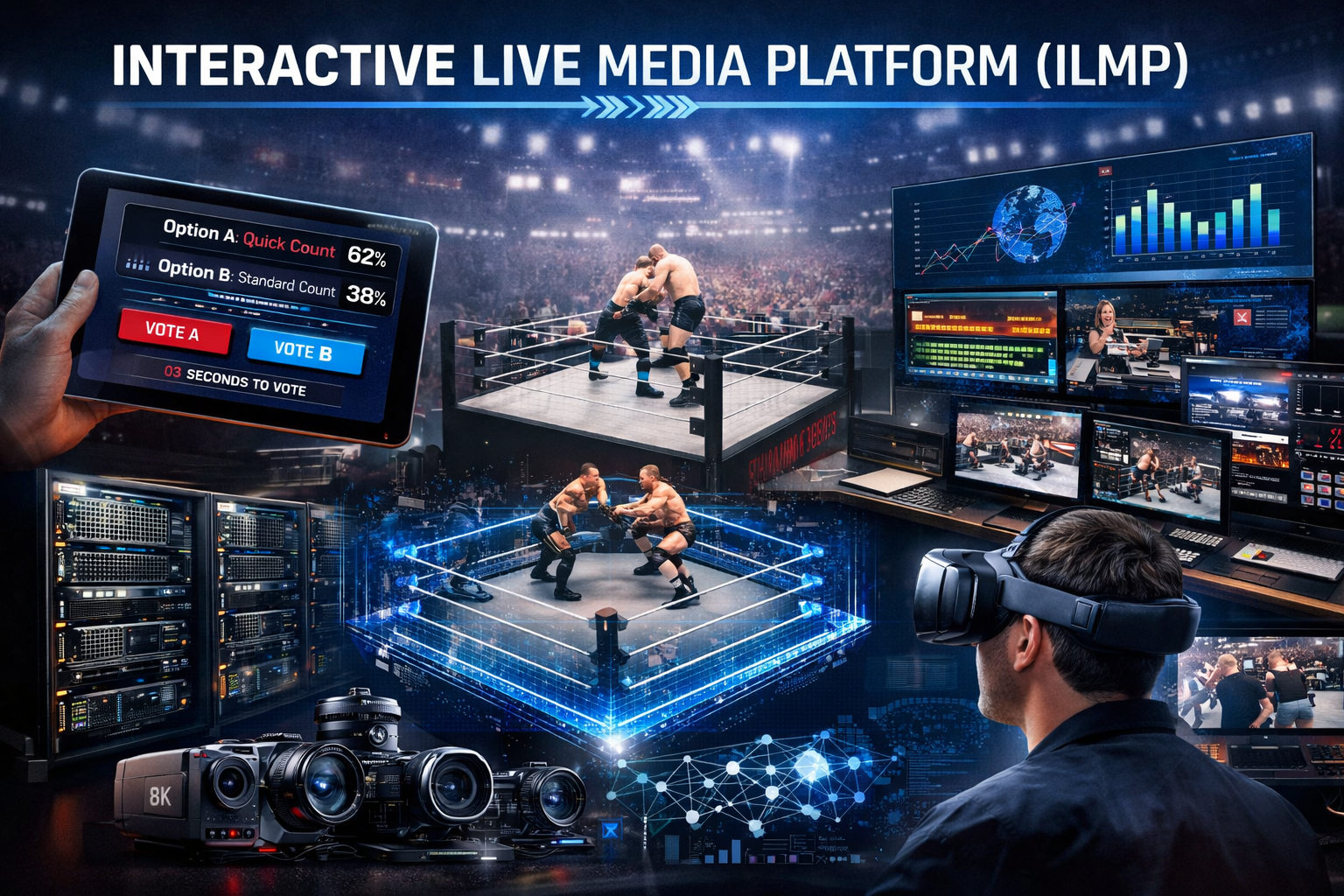
The first pillar introduces live audience input as a controlled variable within match flow and storytelling. Native AEW applications (iOS, Android, Web) using persistent WebSocket connections for sub-2-second latency. Production triggers an “interaction node.” Fans have a 15–20 second window to submit responses. Inputs are aggregated in real-time. Outcomes are pushed to referees via existing earpieces and haptic wearables. Talent executes pre-briefed structural paths based on the audience’s dynamic choices.
2. Spatial Media Capture & Rendering (SMCR) 🕶️
Capture Infrastructure ranging from 360-degree units (Insta360 Titan) to volumetric cinema-grade camera arrays (Blackmagic URSA Mini Pro 12K). GPU clusters (NVIDIA A6000 / H100 class) handle real-time stitching and depth reconstruction, rendering via Unreal Engine with 3–5 second target latency. 🖥️ Fans can use Meta Quest 3 or Apple Vision Pro to navigate spatial perspectives, or use AR frameworks to project a scaled, interactive 3D match directly onto their coffee table.
3. Data Intelligence & Feedback Systems 🧠
Transforms engagement into measurable, actionable intelligence. We capture input distribution patterns, spatial viewpoint selection, and interaction frequency. This creates a proprietary dataset for WBD, allowing for predictive modeling for creative direction and hyper-precise advertising segmentation (driving up Ad CPMs). 🎯
Implementation Roadmap & SDLC Status 🛣️
Phase 3: Architecture & Pilot (Requested Approval)
Duration: 6 Months | Budget: $3M–. Deliverables: Deploy an MVP real-time interaction system, launch beta AEW interactive app, and conduct live pilots with 360 VR capture. Target KPIs: 25% or greater viewer participation, and a 10% increase in average watch time during pilot shows. 📈
Phase 4: Scale & Productization
Duration: 6–12 Months | Budget: $5M–. Deliverables: Full volumetric capture rollout, AR feature launch, and integration of $4.99–.99 premium AR/VR subscription tiers. 💳
The Ultimate Goal: Platform Licensing & B2B Expansion 🤝
Once validated, this system evolves into a licensable platform: the Interactive Live Media Stack (ILMS). By partnering with hardware giants like Blackmagic Design and NVIDIA, WBD can develop modular volumetric capture rigs to license to other sports leagues and venues. This shifts WBD’s identity from a content provider to a highly lucrative technology vendor. 💻
Conclusion: Infrastructure Is the New Content 🏆
The competitive landscape in media is no longer defined by who owns the most content. It is defined by who controls the experience layer. 🌍 This proposal reframes AEW not just as a wrestling promotion, but as a deployment vehicle for next-generation media infrastructure. For WBD, the upside is proprietary technology ownership and massive new B2B revenue categories. 🥇
← Return to Feed